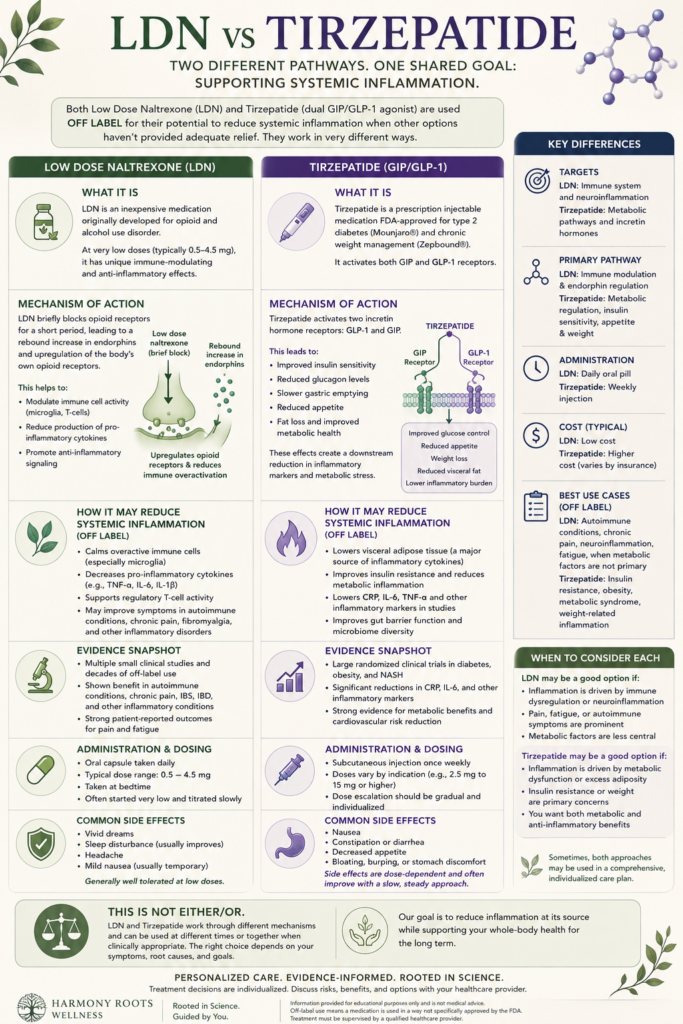

Frequently Asked Questions: LDN vs. Tirzepatide
LDN stands for low-dose naltrexone. Naltrexone is an FDA-approved medication used at standard doses for opioid and alcohol use disorders. At much lower doses, it is prescribed off-label for a variety of conditions, particularly chronic pain and some inflammatory or neuroimmune conditions. (FDA Access Data)
LDN appears to have effects beyond its traditional opioid-receptor blockade, with research suggesting possible effects on neuroimmune signaling and microglial activity. However, the evidence remains limited and researchers are still working to determine which patients are most likely to benefit. (PubMed)
Tirzepatide is a dual GIP and GLP-1 receptor agonist. It is an FDA-approved prescription medication used for specific indications including chronic weight management and type 2 diabetes, with additional FDA-approved indications having been added over time. (FDA Access Data)
Tirzepatide affects appetite, satiety, glucose regulation, insulin sensitivity, gastric emptying, and energy balance.
Because metabolic dysfunction and excess adipose tissue can contribute to chronic inflammatory signaling, improving metabolic health may also reduce inflammatory burden.
LDN is sometimes considered when a person’s symptoms appear to involve neuroinflammation, immune dysregulation, chronic pain, or inflammatory signaling, particularly when conventional approaches have not provided adequate relief.
Research has investigated LDN in conditions including fibromyalgia, multiple sclerosis, Crohn disease, chronic pain, and some inflammatory skin conditions. However, the quality of evidence varies, and larger clinical trials are still needed. (PubMed)
We therefore describe LDN as an off-label, evidence-informed option, rather than a proven treatment for systemic inflammation.
Tirzepatide is not FDA-approved as an anti-inflammatory medication.
However, improving insulin resistance, reducing excess adipose tissue, and improving metabolic health can affect inflammatory pathways. Recent clinical research and meta-analysis data have found reductions in inflammatory biomarkers such as high-sensitivity CRP and IL-6 among people treated with tirzepatide. (PubMed)
For someone whose inflammation appears closely connected with metabolic dysfunction, insulin resistance, visceral adiposity, or obesity, tirzepatide may therefore have benefits that extend beyond the number on the scale.
No. They work through very different biological pathways.
LDN primarily works through opioid-receptor signaling and proposed neuroimmune mechanisms. At low doses, researchers have proposed effects involving microglia and Toll-like receptor signaling, although the exact clinical mechanism remains incompletely understood. (PubMed)
Tirzepatide activates the GIP and GLP-1 receptors, influencing glucose metabolism, insulin secretion, appetite, satiety, gastric emptying, and energy balance. (FDA Access Data)
So while both may potentially influence inflammatory processes, they approach the problem from completely different directions.
No.
Naltrexone itself is FDA-approved for specific indications involving alcohol dependence and opioid blockade. Low-dose use for chronic pain, inflammatory conditions, or neuroimmune symptoms is considered off-label use. (FDA Access Data)
Off-label prescribing is a recognized part of medical practice, but it is important for patients to understand when a treatment is being used outside its FDA-approved indication.
No.
Tirzepatide is FDA-approved for specific medical indications—not for treating systemic inflammation itself. Evidence of reductions in inflammatory biomarkers is an important area of ongoing research, but that does not make “inflammation” an FDA-approved indication. (FDA Access Data)
There isn’t a simple answer.
It depends on why inflammation may be occurring in the first place.
For example, if metabolic dysfunction, insulin resistance, obesity, or visceral adiposity appears to be contributing significantly to inflammatory burden, a medication such as tirzepatide may be particularly relevant.
If symptoms appear more closely associated with chronic pain or neuroimmune dysregulation, LDN may be worth discussing.
And sometimes neither medication is the right answer.
The first step is determining what is driving the symptoms.
Potentially, yes—but this should be determined individually by your healthcare provider.
They work through different mechanisms and do not represent duplicate therapies.
However, combining medications doesn’t automatically mean better results. We consider the patient’s medical history, medications, symptoms, goals, contraindications, and response to treatment before adding another therapy.
No.
LDN is not FDA-approved for weight management and should not be thought of as a substitute for evidence-based medical weight management.
Some people may experience changes in appetite or other symptoms while taking LDN, but weight loss is not an established primary indication.
No.
Although weight management is an important indication, tirzepatide affects several aspects of metabolic physiology, including glucose regulation, insulin sensitivity, appetite signaling, and energy balance.
For appropriate patients, we think about the goal as improving metabolic health and body composition—not simply making the scale go down.
Because more medication isn’t automatically better.
Tirzepatide’s FDA-approved dosing schedule uses gradual dose escalation, with increases occurring after patients have had time to adjust to the medication. (FDA Access Data)
At Harmony Roots, we emphasize a gentle, individualized approach.
We look at:
Appetite and hunger
Weight trajectory
Body composition
Energy
Nutrition
Hydration
GI symptoms
Exercise and muscle preservation
Metabolic markers
Overall response
If someone is doing well at a lower dose, there may not be a reason to rapidly escalate simply because a higher dose exists.
This is an important distinction.
The FDA-approved dosing schedule for tirzepatide has specific starting and maintenance doses. Using doses or schedules outside the approved labeling is an individualized/off-label prescribing decision and should not be presented as an FDA-approved dosing strategy. (FDA Access Data)
In some clinical situations, a provider may consider a more conservative approach based on a patient’s response, tolerability, medical history, and goals.
We don’t believe that every patient needs to reach the maximum dose.
The goal is the lowest effective treatment that provides meaningful benefit while maintaining safety and tolerability.
It may improve tolerability for some patients, but we don’t promise that it will prevent side effects.
Tirzepatide commonly causes gastrointestinal effects such as nausea, diarrhea, constipation, vomiting, abdominal discomfort, and decreased appetite. (FDA Access Data)
A gradual approach can give the body more time to adapt, but individual responses vary.
Our goal is to minimize unnecessary side effects while still achieving meaningful clinical benefit.
Hair shedding has been reported with tirzepatide and other medications associated with substantial weight loss.
In many cases, hair shedding may be related to rapid weight loss, inadequate protein or calorie intake, nutritional deficiencies, or physiologic stress, rather than a direct toxic effect on the hair follicle.
This is one reason we pay attention to how quickly weight is changing and whether you are adequately nourished, rather than focusing exclusively on the number on the scale.
We cannot guarantee that a slower approach will prevent hair loss, but avoiding unnecessarily rapid weight loss may be one component of supporting hair health.
Possibly, but this is an area where we need to be precise.
Research has demonstrated reductions in inflammatory biomarkers with tirzepatide, including hs-CRP and IL-6. (PubMed)
However, we don’t yet know that every person with an elevated inflammatory marker will benefit from tirzepatide, or that treating an inflammatory marker alone improves long-term outcomes.
We treat the patient—not the lab value.
That requires an individualized evaluation.
Inflammation can have many causes, including:
Autoimmune disease
Infection
Metabolic dysfunction
Sleep disorders
Chronic stress
Adiposity
Smoking
Nutritional deficiencies
Chronic inflammatory conditions
Other underlying medical conditions
Tirzepatide isn’t automatically appropriate simply because inflammation is present.
Similarly, LDN isn’t automatically appropriate.
Finding the cause comes first.
No—and we don’t describe it that way.
LDN is a prescription medication.
It isn’t a supplement or natural product.
The more useful distinction is that LDN and tirzepatide target different biological pathways and may be considered for different clinical situations.
Yes.
Because naltrexone blocks opioid receptors, it can interfere with opioid medications and is contraindicated in people currently receiving opioid analgesics or who are opioid-dependent or experiencing acute opioid withdrawal. (FDA Access Data)
This makes a complete medication and substance-use history particularly important before considering LDN.
Your provider will also consider liver health and other individual factors.
Yes.
Tirzepatide has important contraindications and precautions. For example, it is contraindicated in people with a personal or family history of medullary thyroid carcinoma (MTC) or Multiple Endocrine Neoplasia syndrome type 2 (MEN 2). (FDA Access Data)
Your provider will review your medical history, medications, risks, and goals before prescribing it.
For weight management and metabolic health, tirzepatide has substantially stronger clinical evidence.
It has been studied extensively in large randomized clinical trials and has FDA-approved indications for specific metabolic and weight-management conditions. (FDA Access Data)
For LDN, the evidence is much more preliminary and condition-specific.
Recent reviews describe promising findings in selected conditions but emphasize that much of the evidence comes from small studies and that larger, well-designed trials are needed. (PubMed)
We think patients deserve to know that difference.
Off-label prescribing can be appropriate when a licensed clinician determines that an existing medication may reasonably benefit a patient for an indication that is not specifically included in the FDA-approved labeling.
But off-label does not mean experimental in every circumstance—and it also doesn’t mean proven.
Our responsibility is to explain:
What we know.
What we think.
What the research suggests.
And what we don’t yet know.
That distinction is central to informed consent.
That’s exactly when a deeper evaluation may be appropriate.
Rather than automatically adding another medication, we may look at:
Metabolic health
Insulin resistance
Body composition
Sleep
Nutrition
Hormonal changes
Autoimmune conditions
Medications
Chronic infections when clinically indicated
Iron and vitamin deficiencies
Other potential contributors
Depending on the clinical picture, LDN, tirzepatide, or another therapy may—or may not—make sense.
LDN and tirzepatide aren’t competing versions of the same medication.
They work through fundamentally different pathways.
LDN may be considered as an off-label option in selected chronic pain or neuroimmune/inflammatory conditions, although evidence remains limited.
Tirzepatide has strong evidence and FDA-approved indications for metabolic and weight-management conditions, with emerging evidence that it can also reduce inflammatory biomarkers.
At Harmony Roots, our goal is not to prescribe the newest medication or the highest dose.
It’s to understand what your body is telling us and choose the most appropriate tool for the problem we’re actually trying to solve.
This information is educational and does not constitute a diagnosis or recommendation for treatment. LDN use for inflammatory or pain conditions is off-label. Tirzepatide is not FDA-approved specifically to treat systemic inflammation. Treatment decisions should be individualized with a qualified healthcare professional.
If you’ve been anywhere near healthcare or social media in the last few years, you’ve probably heard about GLP-1 medications.
Semaglutide. Tirzepatide. Wegovy. Zepbound.
They’ve become well known for helping people lose weight—but the science behind these medications is much more interesting than weight loss alone.
GLP-1-based medications are changing how we think about obesity, insulin resistance, cardiovascular disease, sleep apnea, metabolic health, and potentially even inflammation.
Some of these benefits are now supported by large randomized clinical trials. Others are emerging areas of research that scientists are actively investigating.
At Harmony Roots Wellness, we believe patients deserve to understand both.
This page explains what GLP-1 medications do, where the evidence is strongest, what researchers are discovering about their effects beyond weight loss, and where we still need more research.
GLP-1 stands for glucagon-like peptide-1.
It is a hormone naturally produced in your body, particularly in the intestine after you eat.
GLP-1 helps communicate between your digestive system, pancreas, brain, and other metabolic tissues.
Among other functions, GLP-1 can:
Increase insulin secretion when glucose is elevated
Reduce glucagon secretion
Slow stomach emptying
Increase feelings of fullness
Reduce appetite
Influence food-reward pathways in the brain
Help regulate blood glucose
Medications that activate the GLP-1 receptor essentially amplify some of these naturally occurring signals.
Not every medication commonly called a “GLP-1” works exactly the same way.
Semaglutide is a GLP-1 receptor agonist.
Tirzepatide activates both the GLP-1 and GIP receptors, making it a dual incretin medication.
Both can reduce appetite and improve metabolic health, but their pharmacology is somewhat different.
We can help determine which medication, if any, is appropriate based on your health, goals, medical history, insurance coverage, and response to treatment.
This is where the evidence is strongest.
Large clinical trials have demonstrated substantial weight loss with medications such as semaglutide and tirzepatide in appropriate patients when used alongside nutrition and physical activity interventions.
But the significance goes beyond the number on the scale.
Excess adipose tissue—particularly visceral fat—is metabolically active. It can influence insulin sensitivity, inflammatory signaling, blood pressure, lipid metabolism, and other aspects of health.
Reducing excess adiposity can therefore affect much more than appearance.
For many patients, weight loss is one part of a larger improvement in metabolic health.
One of the most commonly reported effects of GLP-1 therapy is a reduction in what patients often call “food noise.”
Food noise isn’t a formal medical diagnosis.
It’s a patient-described experience of persistent thoughts about food, cravings, snacking, or feeling preoccupied with eating.
People may describe it as:
“I’m constantly thinking about what I’m going to eat next.”
Or:
“I can eat a full meal and still feel like I need something else.”
GLP-1 medications can increase satiety and decrease appetite, which may make these thoughts feel quieter for some people.
For patients who have spent years believing they simply lacked willpower, this can be a profound change.
GLP-1 medications have been used in diabetes care for years because of their effects on glucose regulation.
They can:
Improve insulin secretion in response to glucose
Reduce inappropriate glucagon secretion
Slow gastric emptying
Reduce food intake
Improve glycemic control
This can help reduce blood glucose and A1C in appropriate patients with type 2 diabetes.
But the metabolic effects don’t necessarily stop at diabetes.
Researchers are increasingly interested in how incretin-based medications affect the broader spectrum of metabolic dysfunction, including insulin resistance and prediabetes.
One of the most important developments in GLP-1 research is that the benefits aren’t limited to weight loss.
In the SELECT trial, more than 17,000 adults with established cardiovascular disease and overweight or obesity—but without diabetes—were randomized to semaglutide or placebo.
Semaglutide reduced the risk of major cardiovascular events, including cardiovascular death, nonfatal heart attack, and nonfatal stroke.
This was a landmark finding because it demonstrated cardiovascular benefit in people with overweight or obesity even without diabetes.
The FDA subsequently approved an expanded indication for Wegovy to reduce the risk of cardiovascular death, heart attack, and stroke in adults with cardiovascular disease and overweight or obesity.
This changed the conversation around these medications.
They aren’t simply “weight-loss drugs.”
For certain patients, they are cardiovascular risk-reduction medications.
Kidney health is another area where the evidence has become increasingly compelling.
In the FLOW trial, people with type 2 diabetes and chronic kidney disease who received semaglutide had a 24% lower risk of the primary composite kidney outcome compared with placebo. The study also found lower cardiovascular and all-cause mortality and a slower decline in kidney function.
These findings suggest that semaglutide may provide kidney protection beyond its effects on blood glucose alone.
Importantly, these findings apply to specific populations and shouldn’t be interpreted as meaning GLP-1 medications prevent kidney disease in everyone.
Another exciting development is the relationship between obesity treatment and obstructive sleep apnea (OSA).
Excess adiposity is an important risk factor for OSA, and weight reduction can improve the severity of sleep-disordered breathing.
In clinical trials, tirzepatide significantly reduced apnea-hypopnea index, body weight, hypoxic burden, and systolic blood pressure in adults with obesity and moderate-to-severe OSA.
In December 2024, the FDA approved Zepbound (tirzepatide) as the first medication specifically indicated to treat moderate-to-severe obstructive sleep apnea in adults with obesity, alongside a reduced-calorie diet and increased physical activity.
This is an important example of how treating metabolic disease can have effects across multiple body systems.
This may be one of the most fascinating areas of emerging GLP-1 research.
Adipose tissue isn’t simply stored energy.
It is an endocrine and immune-active tissue that can participate in inflammatory signaling.
Obesity and insulin resistance are associated with chronic, low-grade inflammation, and researchers have been investigating whether incretin-based therapies can influence inflammatory pathways directly, in addition to the effects expected from weight loss.
And the evidence is becoming increasingly interesting.
A 2025 meta-analysis of 52 randomized controlled trials found that GLP-1 receptor agonists were associated with reductions in several inflammatory biomarkers, including CRP, TNF-α, IL-6, IL-1β, and leptin, along with increased adiponectin.
A separate 2026 systematic review and meta-analysis of 41 randomized trials found that GLP-1-based therapies significantly reduced CRP/high-sensitivity CRP and oxidative-stress markers, although effects on some inflammatory cytokines were less consistent.
Semaglutide specifically has also been associated with reductions in CRP in randomized trials.
These findings are promising.
But there is an important distinction:
The research suggests a potential anti-inflammatory effect, but researchers are still determining how much of this is directly related to incretin signaling versus weight loss, improved insulin sensitivity, changes in adipose tissue, or a combination of mechanisms.
This is an exciting area of research—not a reason to prescribe GLP-1 medication for every inflammatory condition.
PCOS, now called PMOS for good reason… it is a metabolic condition first and as such Tirzepatide, in particular, has been shown to support the physiology behind PMOS.
Insulin resistance and metabolic dysfunction are common in PMOS, particularly among patients with higher body weight.
GLP-1 receptor agonists have been studied in people with PMOS/PCOS, with research showing improvements in measures such as body weight, BMI, waist circumference, and some metabolic markers. Some studies have also reported changes in androgen-related measures.
However, the evidence is still developing.
Recent systematic reviews have found that the evidence base remains relatively small and that certainty varies depending on the outcome being studied.
So while GLP-1 therapy may be a useful tool for some patients with PCOS/PMOS and overweight or obesity, it should not be viewed as a universal treatment for PMOS itself.
PMOS is a complex endocrine condition, and treatment should address the individual’s symptoms, reproductive goals, metabolic health, and overall wellbeing.
Perhaps the most intriguing area of research involves the brain.
GLP-1 receptors are found in areas involved in:
Appetite
Reward
Motivation
Learning
Memory
Metabolism
Researchers are investigating whether GLP-1-based therapies may influence neurological and psychiatric conditions beyond appetite regulation.
Areas being studied include:
Neurodegenerative disease
Alzheimer’s disease
Parkinson’s disease
Addiction
Alcohol use disorder
Substance-use disorders
Cognitive health
This research is exciting—but it is important to distinguish research from established treatment.
At this time, GLP-1 medications should not be presented as proven treatments for Alzheimer’s disease, Parkinson’s disease, or addiction simply because early studies are promising.
The science is still evolving.
Metabolic dysfunction-associated steatotic liver disease (MASLD), formerly commonly called fatty liver disease, is closely connected to obesity and insulin resistance.
Weight reduction and improved metabolic health can significantly benefit liver health.
GLP-1-based therapies are being studied for their effects on liver fat and metabolic liver disease.
The results so far are encouraging, particularly with newer incretin therapies, but the appropriate medication and indication depend on the individual’s diagnosis and the evidence available for that particular treatment.
One of the most important shifts in our understanding of these medications is this:
The scale is only one measurement.
A person may experience meaningful health improvements through:
Improved glucose regulation
Reduced insulin resistance
Lower blood pressure
Improved triglycerides
Improved cardiovascular risk
Reduced liver fat
Improved sleep apnea
Reduced inflammatory biomarkers
Improved mobility
Improved physical function
Weight is one piece of the metabolic picture.
It isn’t the entire picture.
You may have heard the term GLP-1 microdosing online.
This generally refers to using doses lower than the standard doses studied in large clinical trials or using longer intervals between doses.
Interest in lower-dose approaches is growing, particularly among people who:
Experience significant medication side effects
Want slower weight loss
Have a lower weight-loss goal or no weight-loss desired
Want to minimize appetite suppression
Are concerned about losing lean mass
Are using the medication as part of longer-term metabolic management
However, there is an important caveat:
Microdosing is not a standardized, evidence-based dosing strategy for most GLP-1 medications.
The strongest clinical evidence comes from specific medications at specific doses studied in clinical trials.
If a lower-dose or individualized approach is considered we are happy to be a guide to maintain safety.
These medications can be remarkably effective, but they aren’t appropriate for every person.
Potential adverse effects include:
Nausea
Vomiting
Diarrhea
Constipation
Abdominal discomfort
Reduced appetite
Dehydration
More serious complications can occur in some patients.
Medication selection should take into account your medical history, other medications, pregnancy plans, gastrointestinal history, metabolic health, and other individual factors.
Your clinician should also review the medication’s specific contraindications, warnings, and precautions before treatment.
This is an important conversation that doesn’t always get enough attention.
Obesity is a chronic condition, and the biological systems that regulate appetite and body weight don’t disappear when medication is stopped.
Clinical studies have shown that some weight regain can occur after discontinuation of GLP-1 therapy.
That doesn’t mean the medication “failed.”
It means that long-term treatment planning matters.
For some people, long-term medication may make sense.
For others, the treatment plan may eventually change.
Our goal is to help you develop a sustainable strategy rather than promising a temporary fix.
At Harmony Roots Wellness, we don’t believe your worth is measured by your weight.
We also don’t believe that every person needs to lose weight.
Our role is to help you understand your health and your options.
For the right patient, GLP-1 therapy may be one tool that helps improve metabolic health, reduce disease risk, and make healthy behaviors more achievable.
For another patient, a GLP-1 may not be appropriate at all.
That’s why our approach starts with a conversation—not a prescription.
Depending on your circumstances, your evaluation may include:
Medical history
Current medications
Weight history
Blood pressure
Metabolic health
Glucose and A1C
Lipid profile
Kidney function
Liver health
Thyroid function when clinically indicated
Menstrual and reproductive history when relevant
PCOS history
Sleep quality and possible sleep apnea
Nutrition and activity
Previous weight-loss treatments
Your goals and expectations
We want to understand the whole person, not just a number on the scale.
If you’ve spent years being told that you simply need more discipline, we want you to hear something different:
You are not a failure because your body responds biologically to food, hormones, stress, and metabolism.
You deserve healthcare that doesn’t shame you.
You deserve a provider who listens to your history.
You deserve to understand why a treatment is being recommended.
And you deserve to make an informed decision about your own body.
At Harmony Roots Wellness, our medical weight-management approach is provider-led, judgment-free, trauma-informed, and individualized.
GLP-1 medications are among the most important developments in metabolic medicine in decades.
The strongest evidence supports their use for conditions including obesity and type 2 diabetes, and specific medications now have additional FDA-approved indications such as cardiovascular risk reduction and, for tirzepatide, treatment of moderate-to-severe obstructive sleep apnea in adults with obesity.
Beyond those established indications, researchers are investigating potential effects on inflammation, fatty liver disease, PCOS, neurological conditions, addiction, and many other areas.
Some of these findings are compelling.
Some are preliminary.
And some questions haven’t been answered yet.
That’s exactly why we believe in evidence-based, individualized care.
The future of GLP-1 medicine is exciting—but we don’t need to overpromise what the science can already prove.
No.
Several GLP-1-based medications are approved for chronic weight management in people with obesity or overweight plus certain weight-related health conditions, depending on the medication and patient characteristics.
Semaglutide also has an FDA-approved indication for reducing major cardiovascular events in certain adults with cardiovascular disease and overweight or obesity.
There is growing evidence that GLP-1-based therapies can reduce certain inflammatory biomarkers, including CRP.
However, “anti-inflammatory” should not be interpreted as meaning these medications are established treatments for every inflammatory disease. Research is still clarifying the mechanisms and clinical significance of these effects.
They may help some patients with PCOS, particularly those who also have overweight or obesity and metabolic dysfunction.
Research has demonstrated improvements in weight and some metabolic measures, but evidence for reproductive and hormonal outcomes remains less certain.
Tirzepatide has demonstrated significant improvements in obstructive sleep apnea severity in adults with obesity, and the FDA approved Zepbound for moderate-to-severe OSA in adults with obesity in 2024.
For certain patients, yes.
Semaglutide reduced major cardiovascular events in the SELECT trial among adults with established cardiovascular disease and overweight or obesity without diabetes.
Semaglutide reduced clinically important kidney outcomes in a large trial of people with type 2 diabetes and chronic kidney disease. Whether similar benefits apply to other populations is an ongoing area of research.
Weight loss can include loss of both fat mass and lean mass.
That is one reason we don’t focus exclusively on the number on the scale. Adequate protein intake, resistance training, nutrition, and an appropriately paced treatment plan can all be important components of preserving muscle and physical function.
Not necessarily—but this should be discussed before starting treatment.
Some people benefit from long-term therapy, while others may eventually transition to a different strategy. Weight regain after discontinuation is possible, so long-term planning is an important part of treatment.
You don’t need to be embarrassed about your weight.
You don’t need to have “failed” enough diets.
And you don’t need to know which medication you want before you make an appointment.
We’ll help you understand your options and determine whether GLP-1 therapy makes sense for you.
Provider-led. Judgment-free. Evidence-based.
Because weight care should begin with listening—not shame.