“Understanding the vessel we have been given in this lifetime is the key to health.”
—Treanna Anastasia, WHNP-APN
In Chapter 1, we learned that hormones are chemical messengers that allow different parts of your body to communicate.
Now it’s time to meet the organs responsible for producing those messages.
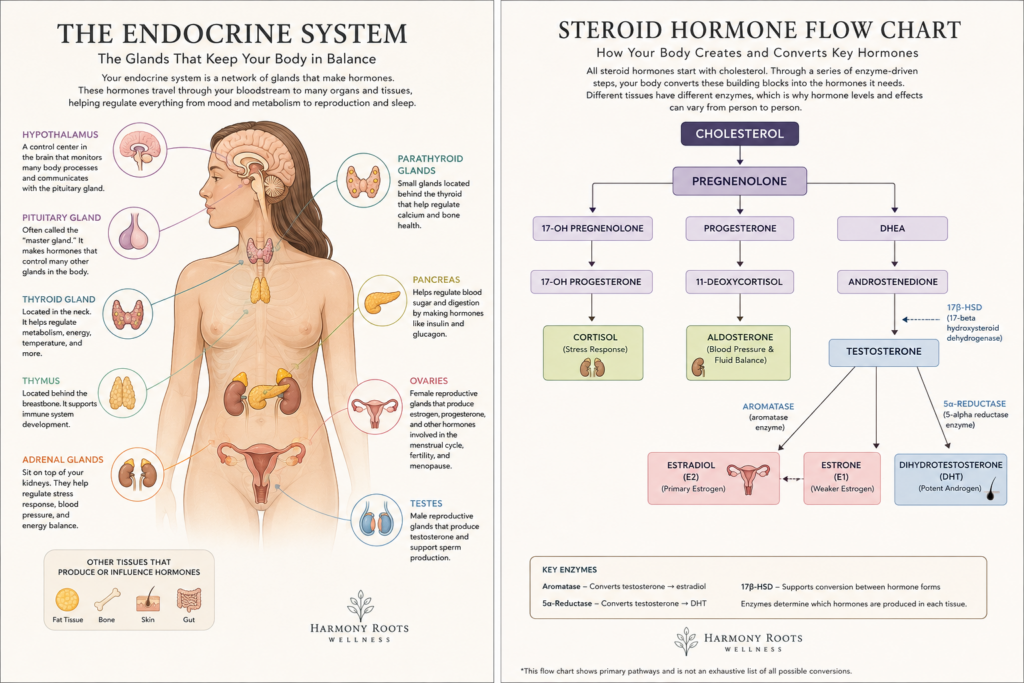
The endocrine system is a network of glands and tissues that work together to regulate nearly every major function in your body. From your metabolism and energy levels to fertility, mood, sleep, blood sugar, muscle growth, bone health, and healthy aging, these organs are constantly communicating through hormones.
One of the most important concepts in hormone health is this:
No endocrine gland works alone.
Your thyroid doesn’t function independently of your brain. Your ovaries communicate with your adrenal glands. Your pancreas influences your reproductive hormones. Even your gut, bones, fat tissue, and vitamin D system participate in this conversation.
When one part of the endocrine system changes, other parts often adapt in response.
Understanding these relationships helps explain why hormone care is rarely about treating a single lab value—it is about understanding the body as an interconnected system.
One of the most common questions I hear is:
“Which hormone is causing my symptoms?”
Sometimes there is a straightforward answer.
But more often, the better question is:
“How is my endocrine system functioning as a whole?”
When someone comes to see me because they’re exhausted, gaining weight, struggling with brain fog, having irregular cycles, experiencing hot flashes, dealing with infertility, noticing changes in mood, or simply feeling unlike themselves, I don’t immediately focus on one hormone.
Instead, I begin asking questions about the entire system.
How is the thyroid functioning?
Is blood sugar well regulated?
Are the ovaries communicating appropriately with the brain?
Could nutrient deficiencies be limiting healthy hormone production?
Is chronic stress changing how the adrenal glands are responding?
Hormones rarely tell a story in isolation.
When we begin understanding the entire endocrine system instead of looking at one gland at a time, the bigger picture often starts to make sense.
The endocrine system is the body’s communication network.
Rather than sending electrical signals like the nervous system, the endocrine system communicates using hormones that travel through your bloodstream to reach target organs and tissues.
Each endocrine gland has a primary role, but they constantly send information back and forth through what healthcare providers call feedback loops.
Those feedback loops allow your body to continually adjust to changes such as:
Sleeping or waking
Eating or fasting
Exercise
Illness
Pregnancy
Puberty
Perimenopause
Menopause
Aging
Physical and emotional stress
This constant communication helps your body maintain homeostasis—a medical term that describes your body’s ability to maintain internal balance despite changes in your environment.
Homeostasis (home-ee-oh-STAY-sis)
Your body’s ability to maintain a healthy internal balance despite constantly changing conditions.
The hypothalamus is a small structure located deep within the brain, but don’t let its size fool you—it serves as one of the body’s primary control centers.
It continuously gathers information from throughout the body, including:
Body temperature
Stress levels
Light and darkness
Nutritional status
Hydration
Blood pressure
Hormone levels
Sleep patterns
Based on that information, it decides which messages need to be sent next.
The hypothalamus communicates directly with the pituitary gland, forming the beginning of several important endocrine pathways that you’ll hear about throughout this library:
HPT Axis – Hypothalamic-Pituitary-Thyroid Axis
HPA Axis – Hypothalamic-Pituitary-Adrenal Axis
HPG Axis – Hypothalamic-Pituitary-Gonadal Axis
Although those names sound complicated, they simply describe the communication pathways between the brain and different endocrine organs.
Just beneath the hypothalamus sits the pituitary gland.
Historically, it’s been called the “master gland,” but many endocrinologists now prefer to think of it as the body’s coordinator.
It releases hormones that tell other endocrine glands when to increase or decrease hormone production.
Some of its major hormones include:
TSH (Thyroid Stimulating Hormone)
ACTH (Adrenocorticotropic Hormone)
LH (Luteinizing Hormone)
FSH (Follicle Stimulating Hormone)
Growth Hormone (GH)
Prolactin
Oxytocin (stored and released here after being produced in the hypothalamus)
Vasopressin/ADH (also produced in the hypothalamus and released by the posterior pituitary)
These hormones influence nearly every endocrine gland in the body.
When the pituitary changes its message, the thyroid, adrenal glands, ovaries, and testes often respond.
The thyroid gland sits at the front of your neck and produces two primary hormones:
Thyroxine (T4)
Triiodothyronine (T3)
These hormones help regulate how efficiently your cells produce and use energy.
Healthy thyroid function supports:
Metabolism
Energy production
Body temperature
Cholesterol metabolism
Digestion
Heart function
Brain health
Menstrual health
Fertility
Healthy pregnancy and fetal development
Skin and hair health
Muscle function
When thyroid hormone levels are too low (hypothyroidism), many body systems slow down. When levels are too high (hyperthyroidism), those same systems speed up.
Supporting thyroid health isn’t simply about taking thyroid medication when it’s needed. It’s also about making sure the thyroid has the building blocks it needs to function well.
Examples include:
Adequate iodine (not excessive)
Selenium
Iron (when deficient)
Zinc
Vitamin D (when deficient)
Treating autoimmune thyroid disease when present
Prioritizing restorative sleep
Managing chronic stress
Supporting overall metabolic health
Optimizing thyroid health may improve energy, cholesterol metabolism, menstrual regularity, fertility, pregnancy health, mood, and overall well-being in people with thyroid disorders.
Sitting just above each kidney are two small organs called the adrenal glands. Despite their size, they play an enormous role in helping your body adapt to everyday life.
The adrenal glands don’t simply make “stress hormones.” They help regulate your response to physical stress, emotional stress, illness, injury, dehydration, changes in blood pressure, blood sugar, immune function, and even the production of other hormones.
The adrenal glands have two main parts:
The adrenal cortex, which produces steroid hormones.
The adrenal medulla, which produces catecholamines like epinephrine (adrenaline) and norepinephrine.
Throughout this library, we’ll primarily focus on the adrenal cortex because of its close relationship with hormone health.
The adrenal cortex produces several important hormones, including:
Cortisol – Helps regulate your stress response, immune system, blood sugar, inflammation, and metabolism.
Aldosterone – Helps regulate sodium, potassium, hydration, and blood pressure.
DHEA (Dehydroepiandrosterone) and DHEA-S (Dehydroepiandrosterone Sulfate) – Often referred to as prohormones because they serve as building blocks for other steroid hormones.
Androstenedione – Another precursor hormone that can be converted into testosterone or estrogens depending on which enzymes are present in a particular tissue.
Unlike cortisol or aldosterone, DHEA and androstenedione are not usually the final destination—they’re part of the pathway. Your body can use them to create additional hormones where they’re needed.
This is another reminder that hormones rarely work in isolation. The body is constantly modifying and converting hormones based on the needs of individual tissues.
During the reproductive years, the ovaries or testes produce the majority of sex hormones.
As ovarian hormone production changes during menopause, adrenal hormones become an increasingly important source of androgen precursors that can be converted into estrogens and testosterone in tissues throughout the body.
This doesn’t mean the adrenal glands “take over” after menopause—but they become a more important contributor to overall hormone balance.
The internet is full of products promising to “fix” your adrenal glands or reverse “adrenal fatigue.” While chronic stress absolutely affects how we feel, “adrenal fatigue” is not a recognized medical diagnosis. True adrenal disorders, such as adrenal insufficiency or Cushing syndrome, are real medical conditions that require proper evaluation and treatment.
That doesn’t mean there’s nothing we can do to support healthy adrenal function.
Healthy adrenal physiology is supported by:
Prioritizing restorative sleep
Eating enough protein and overall calories
Managing chronic stress in sustainable ways
Regular movement (without chronic overtraining)
Treating underlying medical conditions
Correcting nutrient deficiencies when present
Building time for recovery after illness, injury, or prolonged stress
The goal isn’t to eliminate cortisol. Cortisol is essential for life.
The goal is to support a healthy, flexible stress response.
Cortisol (KOR-tih-sol)
A steroid hormone that helps regulate your body’s response to stress, inflammation, blood sugar, blood pressure, and energy.
DHEA
A hormone produced primarily by the adrenal glands that serves as a precursor for testosterone and estrogens.
Androstenedione
A naturally occurring steroid hormone that can be converted into testosterone or estrogens.
Many people think of the ovaries simply as organs that release eggs.
In reality, they are among the body’s most active endocrine organs during the reproductive years.
In addition to releasing an egg during ovulation, the ovaries produce several hormones that influence nearly every major organ system.
These include:
Estradiol (E2) – The primary estrogen during the reproductive years.
Progesterone – Produced primarily after ovulation by the corpus luteum.
Testosterone – Yes, ovaries naturally produce testosterone.
Inhibin – Helps regulate FSH production by the pituitary.
Anti-Müllerian Hormone (AMH) – Reflects the number of remaining ovarian follicles and is often used as a marker of ovarian reserve.
These hormones influence much more than fertility.
They help regulate:
Bone health
Brain function
Mood
Sleep
Muscle mass
Cardiovascular health
Skin health
Vaginal and urinary health
Libido
Metabolism
Fertility
One of the most common misconceptions is that the ovaries completely stop functioning after menopause.
They don’t.
Their role changes.
After menopause, the ovaries no longer regularly release eggs and produce much lower amounts of estradiol and progesterone.
However, they continue producing small amounts of testosterone and androstenedione for many years.
Those androgens can then be converted in fat tissue, skin, muscle, and other organs into estrone (E1) through the action of the enzyme aromatase.
As a result:
Estradiol (E2) becomes much lower.
Estrone (E1) becomes the primary circulating estrogen after menopause.
The ovaries continue contributing to hormone health, even though their role is different than during the reproductive years.
Understanding this helps explain why menopause is a transition in hormone production—not simply the ovaries “shutting off.”
There are three primary estrogens in the human body:
Estradiol (E2) – The most potent estrogen during the reproductive years.
Estrone (E1) – The primary estrogen after menopause.
Estriol (E3) – Produced in significant amounts during pregnancy and considered the weakest of the three major estrogens.
We’ll devote an entire chapter to understanding each one later in this volume.
The testes are the body’s primary source of testosterone.
They also produce sperm and small amounts of estradiol through the action of the enzyme aromatase.
Testosterone supports:
Muscle mass and strength
Bone density
Libido
Energy
Mood
Red blood cell production
Body composition
Cognitive function
Testosterone production changes naturally over time.
Levels rise dramatically during puberty, remain relatively stable through early adulthood, and then gradually decline with age.
On average, testosterone levels decrease by approximately 1% per year after age 30–40, although this varies widely from person to person.
Factors that influence testosterone production include:
Genetics
Sleep quality
Body composition
Physical activity
Chronic illness
Medications
Nutrition
Stress
A gradual decline is considered a normal part of aging.
However, when symptoms such as low energy, reduced libido, decreased muscle mass, difficulty concentrating, or mood changes occur alongside consistently low testosterone levels, a medical evaluation may be appropriate.
Like all hormone therapy, treatment decisions should be based on symptoms, laboratory findings, overall health, and individual goals—not age alone.
One of the most empowering things you can learn about the endocrine system is that hormone production is not static.
Your body is constantly adapting to changes in sleep, nutrition, exercise, illness, stress, aging, medications, and life stage. While some changes—such as menopause or age-related testosterone decline—are natural transitions, others may improve when we identify and address the underlying factors contributing to them.
Hormone therapy is one tool we use to support the endocrine system. It’s most effective when considered alongside the bigger picture: nutrition, movement, sleep, mental health, metabolic health, and individualized medical care.
You’ve now met four of the major endocrine organs responsible for producing and regulating hormones throughout your body.
In Part 3, we’ll explore how the pancreas, gut, fat tissue, bones, and vitamin D system continue this conversation—and why these organs are just as important to hormone health as the thyroid or ovaries.