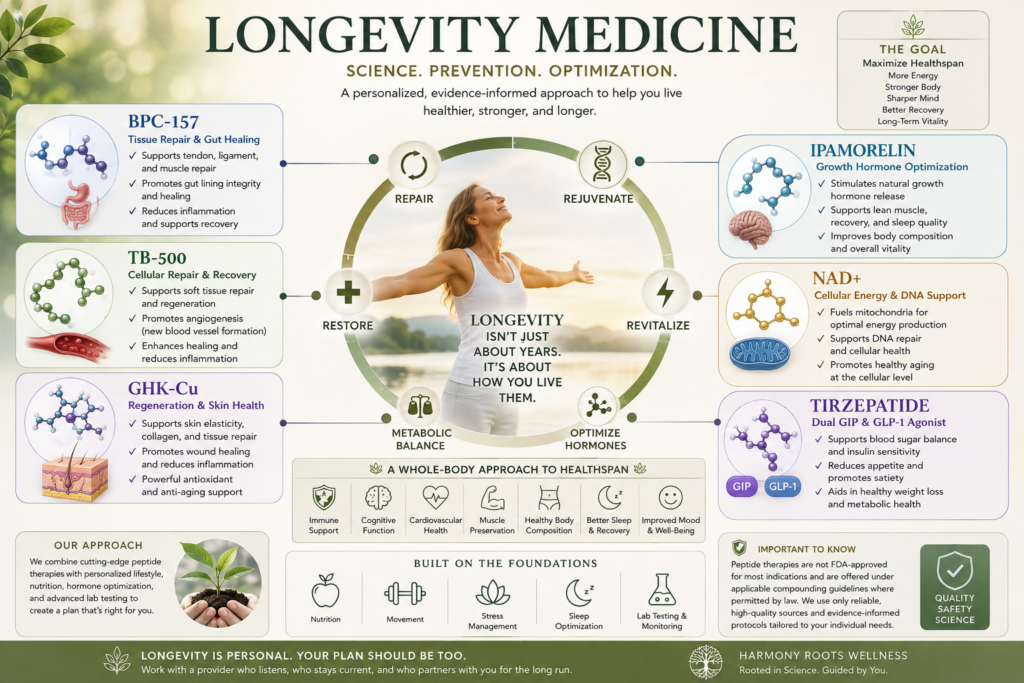
Longevity medicine isn’t about trying to stop aging.
It’s about understanding how the body changes over time—and looking for evidence-informed ways to support metabolic health, muscle preservation, recovery, sleep, hormonal health, cognition, and overall function as we age.
At Harmony Roots Wellness, we take a personalized approach to longevity medicine that may include:
Our goal isn’t simply to help you live longer.
It’s to help you live well for as long as possible.
Longevity medicine is an emerging area of healthcare focused on healthspan—the years of life spent in good health, physical function, and independence.
Traditional medicine often focuses on treating disease after it appears.
Longevity medicine asks an additional question:
What can we do today to preserve function and reduce preventable decline in the years ahead?
That may mean identifying insulin resistance before diabetes develops.
It may mean preserving muscle before significant muscle loss occurs.
It may mean addressing poor sleep before chronic sleep disruption begins affecting metabolic and hormonal health.
It may mean evaluating hormonal changes, nutrition, cardiovascular risk, metabolic health, and physical function together rather than treating each concern as completely separate.
Longevity medicine is ultimately about prevention, function, and healthspan.
Peptides are short chains of amino acids.
Your body naturally produces thousands of peptides that participate in communication between cells and tissues.
Some peptides act as hormones.
Some influence immune signaling.
Some participate in tissue repair.
Some regulate appetite and metabolism.
Others influence growth hormone signaling, inflammation, or cellular processes.
This is why peptide medicine is such an interesting area of research.
Peptides aren’t one category of medication with one mechanism.
Each peptide has its own biology, evidence base, potential benefits, limitations, and risks.
Some have extensive human research.
Some have early human research.
Others have primarily preclinical evidence.
We believe those differences matter.
This distinction is important.
You may hear:
“That peptide isn’t FDA-approved, so there is no evidence.”
That’s not necessarily true.
FDA approval and scientific evidence are two different concepts.
FDA approval means that the FDA has evaluated a specific drug product for specific uses through its regulatory process.
Scientific evidence is broader.
Researchers may study a therapy through:
A therapy can therefore have published scientific research without having an FDA-approved indication.
But the opposite is equally important:
Scientific evidence does not automatically mean that a therapy has been proven safe or effective for every condition or every patient.
The strength and quality of the evidence matter.
At Harmony Roots, we believe patients deserve to know where a therapy falls on that spectrum.
We don’t use the phrase “evidence-based” to mean:
“FDA-approved.”
We use it to mean that we look carefully at the available scientific literature and ask:
That last question is especially important.
Research-informed medicine requires scientific humility.
We can be interested in emerging therapies without pretending that emerging therapies are already established therapies.
Not every peptide belongs in the same category.
We think about emerging therapies along a spectrum.
Strong human evidence and/or FDA-approved uses exist for the specific therapy and indication.
Human research exists, but evidence may be limited, preliminary, inconsistent, or insufficient for an FDA-approved indication.
Evidence may primarily come from preclinical research, early human studies, or limited clinical experience.
There isn’t currently enough reliable evidence for us to recommend the therapy.
Being interested in emerging medicine does not mean believing everything marketed as “longevity.”
Sometimes the most evidence-based answer is:
We don’t know yet.
Metabolic health is one of the most important foundations of healthy aging.
Insulin resistance, impaired glucose regulation, visceral adiposity, and declining muscle mass can contribute to cardiometabolic disease over time.
At Harmony Roots, metabolic care may include nutrition, movement, resistance training, sleep optimization, laboratory evaluation, and medication when clinically appropriate.
Tirzepatide is a medication that activates both the GIP and GLP-1 receptors.
These pathways are involved in glucose regulation, insulin secretion, appetite, satiety, and energy balance.
Tirzepatide has been extensively studied in humans and is FDA-approved under specific brand-name products for specific indications, including type 2 diabetes and chronic weight management.
For appropriate patients, tirzepatide may be an important part of a comprehensive metabolic-health plan.
But we don’t view tirzepatide simply as a “weight-loss shot.”
The broader goal is to improve metabolic health while supporting:
Medication is one tool.
It is not the entire treatment plan.
Some peptides interact directly or indirectly with endocrine signaling.
Depending on the therapy, researchers are studying pathways involving:
This is one reason peptide therapy can sometimes overlap with hormone optimization and metabolic medicine.
But hormones and peptides shouldn’t be treated as interchangeable.
A peptide is not automatically a hormone, and manipulating one signaling pathway can affect others.
That is why individualized evaluation matters.
Some peptides are being investigated for pathways involved in tissue repair, inflammation, vascular signaling, and recovery.
Examples include BPC-157 and TB-500-related compounds.
These are interesting areas of preclinical and translational research.
However, the human clinical evidence for many of these therapies remains limited compared with established medications.
That distinction matters.
Rather than saying:
“BPC-157 heals injuries.”
We believe it is more responsible to say:
BPC-157 is an investigational peptide with promising preclinical research, but robust human clinical evidence establishing its safety and effectiveness for routine treatment of injuries remains limited.
That is the difference between marketing and evidence-informed medicine.
Another area of longevity research involves growth hormone and IGF-1 signaling.
Peptides such as growth-hormone-releasing peptides and growth-hormone secretagogues have been studied for their ability to influence endogenous growth hormone secretion.
Research has investigated these pathways in areas including body composition, recovery, and aging-related changes.
But more is not necessarily better.
Growth hormone biology is complex, and increasing growth hormone signaling can have metabolic consequences.
For that reason, these therapies require careful patient selection, informed consent, and appropriate monitoring rather than simply being treated as “anti-aging injections.”
One of the most important aspects of healthy aging isn’t simply body weight.
It’s physical function.
As we age, maintaining muscle and strength becomes increasingly important.
Loss of muscle and strength can contribute to:
That is why our longevity approach emphasizes:
Protein + resistance training + adequate nutrition + metabolic health + recovery
before reaching for a peptide.
Some growth-hormone-related therapies have been investigated for effects on lean body mass and physical function, but evidence varies considerably among compounds.
We don’t want to simply make the scale smaller.
We want to help preserve the body that carries you through life.
Sleep is one of the most important longevity interventions we have.
Poor sleep can affect:
Several peptides and peptide-related compounds have been investigated for sleep-related pathways.
But we start with a more fundamental question:
Why aren’t you sleeping?
Sometimes the answer is sleep habits.
Sometimes it’s menopause.
Sometimes it’s anxiety.
Sometimes it’s sleep apnea.
Sometimes it’s medications.
Sometimes it’s metabolic or hormonal changes.
And sometimes additional therapies may be appropriate.
The peptide should never replace figuring out why the patient isn’t sleeping.
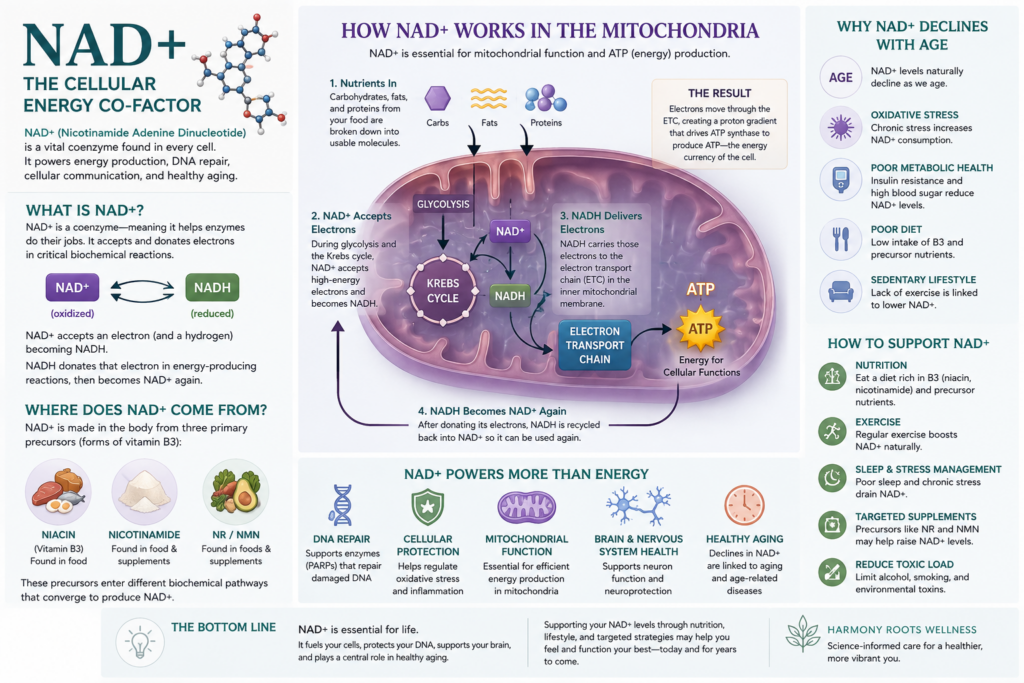
NAD⁺—nicotinamide adenine dinucleotide—is a molecule involved in cellular metabolism, redox reactions, mitochondrial function, DNA repair, and cellular signaling.
NAD⁺ biology has become an important area of aging research.
Human studies have investigated NAD-related interventions and NAD precursors, including nicotinamide riboside and NMN.
The science is promising, but many proposed longevity applications remain under investigation.
This is exactly the kind of situation where we believe patients deserve nuance:
Interesting science does not automatically equal a proven anti-aging treatment.
We can be excited about the research while remaining honest about its limitations.
Fatigue is one of the most common symptoms patients experience—and one of the easiest to oversimplify.
Before considering a peptide for fatigue, we want to ask:
Some peptide and NAD-related pathways are being investigated in relation to cellular energy and fatigue.
But a peptide should not be used to cover up an unexplained medical problem.
We start by looking for the reason.
Hormones change throughout life.
Menopause, perimenopause, declining testosterone, thyroid disorders, insulin resistance, and other endocrine changes can influence:
Hormone therapy may be appropriate for some patients.
It may not be appropriate for others.
Our longevity approach considers hormonal health as one component of the larger endocrine and metabolic picture.
We don’t treat a laboratory value in isolation.
We treat the person.
This is an area where transparency is especially important.
A compounded medication is not FDA-approved.
FDA does not review compounded drugs through the same premarket approval process used for FDA-approved medications. Federal law also places specific requirements and limitations on compounding under sections 503A and 503B.
That does not mean every compounded medication is inherently ineffective.
It does mean that patients should understand what they are receiving, where it came from, what evidence supports the active ingredient, and what remains uncertain.
Compounding must also comply with applicable federal and state requirements.
We do not represent compounded peptides as generic versions of FDA-approved medications.
And we do not use the fact that a medication is compounded as evidence that it is safer, better, or more effective.
Tirzepatide and semaglutide deserve additional caution because FDA’s regulatory position around compounding these medications has been changing.
In April 2026, FDA proposed excluding semaglutide, tirzepatide, and liraglutide from the 503B bulk drug substances list, stating that it had not identified sufficient clinical need for outsourcing facilities to compound these substances from bulk drug substances.
FDA’s current compounding framework also distinguishes between patient-specific 503A compounding and 503B outsourcing facilities, with different legal requirements applying to each.
Because regulatory requirements can change, we evaluate medication availability and compounding options based on the rules and evidence in effect at the time of treatment.
Our priority is patient safety and appropriate medical care—not maintaining access to a particular product at all costs.
At Harmony Roots, our interest in emerging medicine is grounded in curiosity and caution.
We ask:
This is what informed consent should look like.
Our approach to emerging therapies is also informed by experience with research oversight.
Treanna Anastasia, WHNP-APN, participates as a member of an Institutional Review Board (IRB), contributing to the ethical review and oversight of research involving human participants.
That experience reinforces an important principle:
Patients deserve to understand both what science knows and what science does not yet know.
IRB participation does not mean that an investigational therapy is FDA-approved, nor does it independently authorize clinical prescribing.
Instead, it informs our commitment to ethical, transparent, research-literate medical care.
The phrase anti-aging can be misleading.
Aging isn’t a disease we can simply turn off.
Instead, we’re interested in:
How long you remain healthy, strong, mobile, cognitively functional, and independent.
How well your body responds to changes in nutrition, activity, stress, and illness.
Maintaining strength and functional capacity.
Supporting the body’s ability to recover from exercise, illness, and injury.
Understanding age-related changes in endocrine function and treating deficiencies or disorders when appropriate.
Identifying modifiable risk factors before they become major health problems.
Before discussing peptides, we want to understand you.
Your evaluation may include:
Depending on your situation, laboratory testing may include:
We don’t order every test on everyone.
Testing should answer a clinical question.
There is a lot of noise in the longevity industry.
Expensive supplements.
Extreme diets.
Unproven biomarkers.
Hundreds of laboratory tests.
“Anti-aging” promises.
Peptides marketed as miracle treatments.
We take a different approach.
Sleep.
Nutrition.
Movement.
Strength.
Relationships.
Mental health.
Metabolic health.
Preventive care.
Hormones.
Nutrients.
Insulin resistance.
Inflammation.
Body composition.
Cardiovascular risk.
Consider evidence-informed medical therapies—including emerging therapies—with transparent discussion of what is known and what remains uncertain.
There isn’t one longevity protocol.
A 32-year-old endurance athlete doesn’t need the same plan as a 62-year-old experiencing muscle loss.
A person struggling with insulin resistance doesn’t need the same approach as someone whose primary concern is recovery from an injury.
Someone experiencing menopause may need a very different conversation than someone concerned about declining physical function.
Personalized medicine means starting with the person—not the peptide.
Some peptides are FDA-approved medications for specific conditions. Many other peptides used or discussed in longevity medicine do not have FDA-approved indications.
FDA approval is specific to the drug, formulation, indication, route, and other conditions of approval.
No.
FDA approval and scientific evidence are different concepts.
Some non-approved therapies have human research, while others have primarily preclinical evidence.
The quality and amount of evidence must be evaluated individually.
No.
Compounded drugs are not FDA-approved and should not automatically be represented as equivalent to FDA-approved products.
Safety depends on the specific peptide, formulation, route, dose, patient, and duration of use.
Some therapies have substantial human safety data.
Others have limited information.
FDA has identified safety and quality concerns for certain peptide substances proposed for compounding.
Some peptide and NAD-related pathways are being investigated for fatigue and cellular-energy-related outcomes.
However, evidence varies considerably.
We first evaluate potential medical causes of fatigue rather than assuming a peptide is the answer.
Some peptide and growth-hormone-related pathways have been studied in relation to lean body mass and physical function.
However, preserving muscle begins with adequate nutrition, protein intake, resistance training, sleep, and appropriate medical care.
For appropriate patients, tirzepatide may be part of a comprehensive metabolic-health and weight-management plan.
It should not be viewed as a stand-alone “longevity drug.”
Our goal is to use medications when appropriate while also addressing the underlying factors that influence metabolic health.
No.
Sleep, nutrition, resistance training, cardiovascular exercise, stress management, social connection, and preventive healthcare remain the foundation of healthy aging.
We believe you deserve to know not only what we’re offering, but why we’re offering it, what the evidence says, and where the uncertainties remain.
Because the future of medicine shouldn’t require choosing between innovation and scientific rigor.
We believe you can have both.
If you’re interested in:
you don’t need to arrive knowing which peptide you want.
You don’t need to arrive with a protocol.
We’ll start with you.
Harmony Roots Wellness
Fort Collins, Colorado
Science-informed. Person-centered. Judgment-free.
Longevity and peptide medicine are individualized medical services. Some therapies discussed on this page are FDA-approved for specific indications, while others are investigational, emerging, or may be compounded and are not FDA-approved.
The presence of scientific research does not establish that a therapy is safe or effective for every condition or patient. Evidence varies substantially among individual therapies.
Treatment decisions are based on the available evidence, applicable federal and Colorado laws and regulations, clinical judgment, patient preferences, and an individualized assessment of risks and benefits.
Compounded medications are not FDA-approved and are subject to specific federal and state requirements. Treatment availability may change as scientific evidence, pharmacy availability, and regulatory requirements evolve.
This page is educational and does not guarantee that any particular therapy will be recommended or prescribed.